Harmonygrams and melodygrams
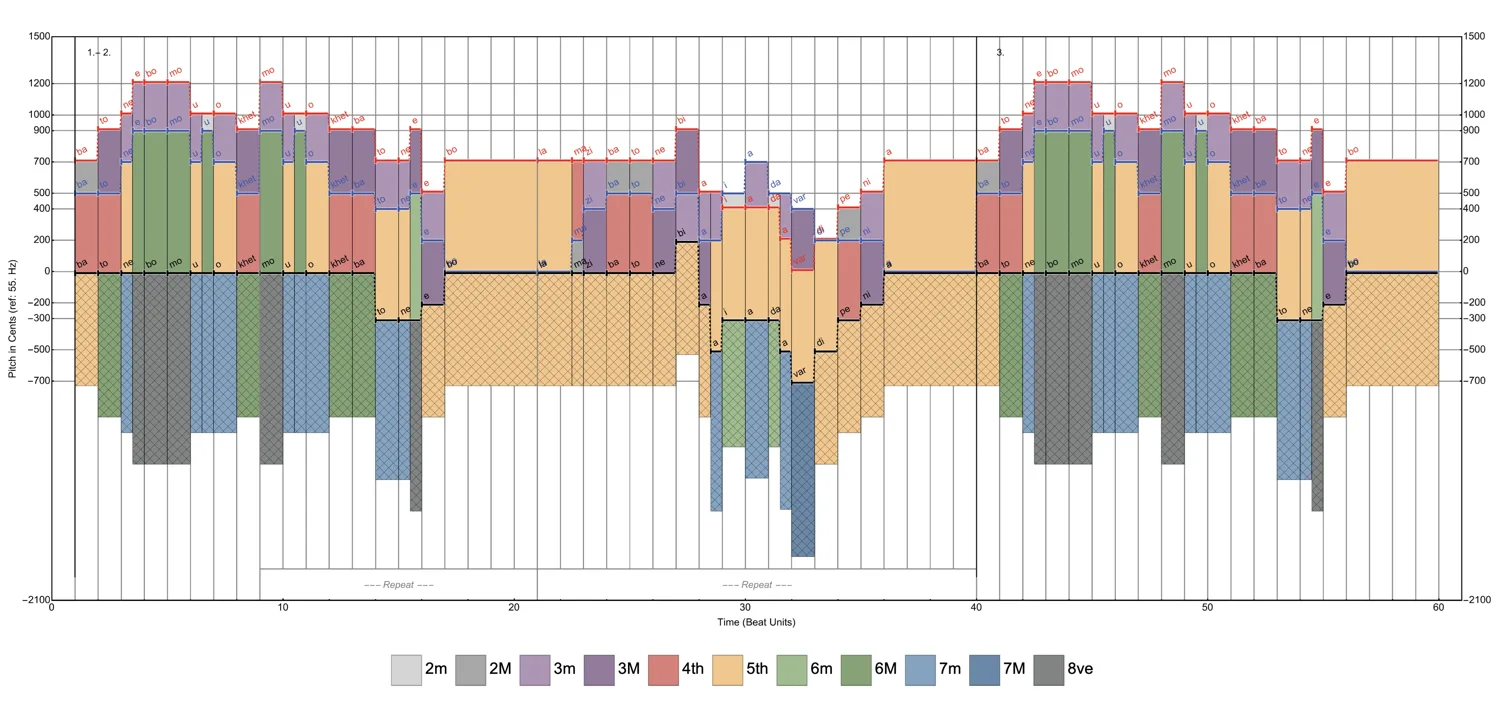
In short: A melodygram shows the pitch curves of all voices in one picture. A harmonygram additionally colours the distances between the voices so that fifths, fourths, octaves and thirds can be recognised by colour. You see the harmony of a song without having to read music.
Video: how a harmonygram is made
The video (about 1½ minutes) shows step by step the way from the score via the melodygram to the colour-coded intervals, using the song Sabodisho Guruli.
The video is also part of the SongExplorer manual (chapter 7, “Understanding songs without sheet music”).
Why harmonygrams?
Traditional five-line notation is not ideal for Georgian music. It is based on twelve-tone equal temperament, which does not fit the traditional tuning of Georgian music and can, for example, introduce artificial semitones into a transcription. It also makes the harmonic side of the music hard to see. Georgian singers think “vertically”: they hear chords intuitively and rapidly adjust their intonation to reach pure intervals at particular places. For singers used to scores, chords have to be deciphered place by place.
Melodies, by contrast, we recognise quickly in a score, simply from the ups and downs of the notes. Recognising harmonies is slow thinking. The harmonygram aims to make harmony as quickly readable as melody.
How a harmonygram is built
- The individual voices are shown as note sequences in “Global Notation” (Killick). This is the melodygram.
- The vertical distances between the voices are colour-coded by interval.
- The interval between the bass (always the lowest voice in the investigated corpus) and the top voice is shown as a vertical mirror image below the bass, whose note trajectory serves as the reference curve.
Harmonygrams contain essentially the same information as the score but offer additional possibilities:
- They can be computed from scores, as can melodygrams. Some distortions caused by Western notation can be corrected algorithmically.
- The chord progression of a whole song can be grasped even by laypeople, because it comes down to simple visual patterns.
- They can also be computed directly from the pitch trajectories of recordings and so be used for field recordings, particularly well with larynx microphones.
For practice
In the SongExplorer you switch on the interval areas under ⚙ Settings → Harmonygram (key H). If you sing the middle or lower voice, the areas show you which interval you should be at relative to the other voice. With “pure only” you colour just unison, fourth, fifth and octave and see how much a song builds on these “empty” sonorities.
The detailed companion document Georgian songs without sheet music (German; version 3.0, PDF) contains the basics and practice notes on individual songs. It is meant as personal inspiration, not as a scholarly treatise.
Song collection
There is a collection of 44 Georgian songs in various melodygram and harmonygram representations, each with a scanned score, in single-line form and in a phrase-by-phrase layout. The collection will be linked here once its storage is decided.
Talk and publications
A 20-minute video of the talk (AAWM 2024, Bologna): youtu.be/8pWI9z_SSUM
- Scherbaum, F., Mzhavanadze, N. (2024). Harmonygrams: A Graphical Notation System for Three-Voiced Music Facilitating the Perception of Harmonies. AAWM 2024, Bologna.
- More publications: Publications
Song collection
The song collection offers 44 Georgian songs as melodygrams and harmonygrams to download.