Song collection: 44 Georgian songs as harmonygrams
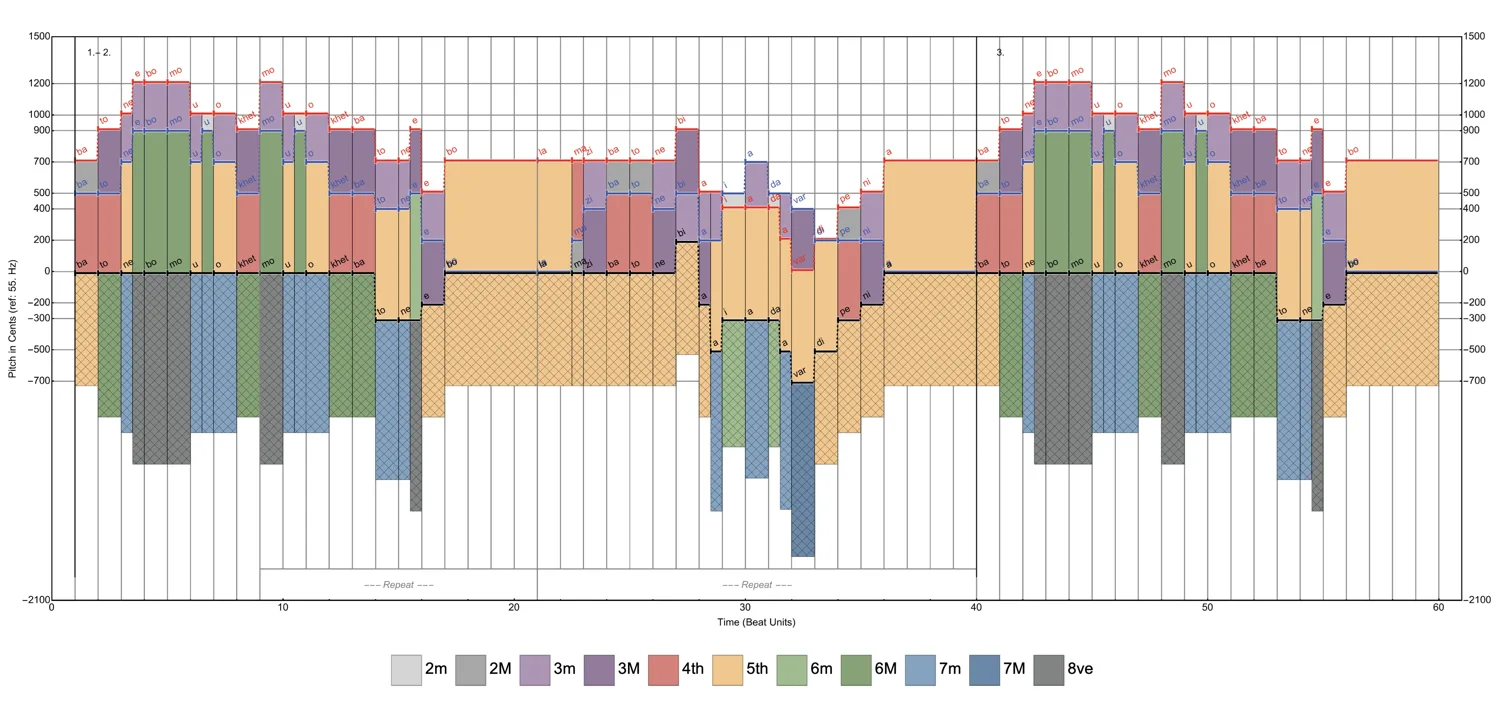
In short: This collection contains 44 selected Georgian songs as melodygrams and harmonygrams, plus the scores they were computed from. It is for anyone who wants to understand the harmony of traditional Georgian polyphony or learn the songs without sheet music.
Read first or watch first
- A 20-minute video introduces the topic: From Western scores to harmonygrams. The presentation at the Bologna conference (2024) is also available as a video, and the generation video shows the individual steps in one minute.
- How harmonygrams are built and read is explained in Harmonygrams: A Graphical Notation System for Three-Voiced Music (18 pages, Scherbaum and Mzhavanadze, 2024).
- Harmonygrams in practical exercises (36 pages) is a logbook of personal notes and exercises on individual songs, meant as a starting aid for practice. It claims neither completeness nor scientific rigour.
- A German version of both documents: Georgische Lieder ohne Noten verstehen.
The songs
Alilo (2), Aragvis Piruli, Batonebis Nanina, Batonebis Simghera, Batonebo (2), Deda Mogikvdesa, Deli deli, Dghes Saghmrto Man Madlman, Didavoi Nana, Dideba, Erekles Mravalzhamier, Es Akvani Kharatuli, Gighini, Ghmerti Upali, Heyamoli, Ia Patonepi, Iavnana, Ima Mtaze, Jvaris Tsinasa, Jvarsa Shensa, Kriste Aghsdga, Lale, Lazare, Lazhgvash, Lile, Maspindzelsa, Misdevs Mela Lomsa, Mze Shina, Nana (2), Nanina, Naninada Batonebo, Ortameluri, Samshoblo, Sedeko, Shen Khar Venakhi, Sisatura, Thebrone, Tsmindao Ghmerto, Va Giorko, Varado, Zruni Glola.
Each PDF contains all 44 songs one after another (between 6 and 20 MB).
The files
Scores
- Scores of all songs (20 MB)
In the scores each voice is on its own system, with the text under every note. The scores are the starting point for all representations. They are included for completeness and for comparison with other song collections.
12-TET representation (12 Tone Equal Temperament, as notated in the score)
| Representation | Single line | In phrases |
|---|---|---|
| Melodygrams | ||
| Harmonygrams | ||
| Harmonygrams, pure intervals only |
Scale-Degree-Index (SDI) representation
| Representation | Single line | In phrases |
|---|---|---|
| Melodygrams | ||
| Harmonygrams | ||
| Harmonygrams, pure intervals only |
Melodygrams and harmonygrams come in two layouts. The single-line layout shows the whole song “in one piece”, which suits short songs best. The phrases layout splits the song into shorter sections stacked one below the other, which is clearer for longer songs. How the 12-TET and SDI representations differ, and how tuning distortions of the score can partly be corrected computationally, is explained in the concept document above.
Notes on the scores and lyrics
All visualisations are computed from digital scores typeset in MuseScore. To make melodygrams and harmonygrams simple and error-free to compute, each voice is on a separate system and every note carries a piece of text. Hyphens for melismas were deliberately omitted so that the lyrics stay legible in the graphics. For a uniform Latin spelling of the Georgian texts, all accents and punctuation were left out and everything is lower case.
The accuracy of the scores (some adapted from freely available scores) and the lyrics is not guaranteed.
Licence
Where the copyright is held by the author, the material is available under the Creative Commons Attribution-NonCommercial-ShareAlike 4.0 International licence (CC BY-NC-SA 4.0). You may use it for pretty much anything except making money.
Questions, comments or requests for other songs from the archive are welcome by email (see About).