Understanding polyphony
Georgia sings in several voices. In 2001 UNESCO proclaimed Georgian polyphonic singing a Masterpiece of the Oral and Intangible Heritage of Humanity, and since 2002 researchers have met every two years at symposia on traditional polyphony. On this page you will find out what makes this music special and get to know some of the people and places behind it.
Why use a computer?
Today computers let us hear and measure music in new ways, for example by following the pitch of every single voice. We do not see this as a replacement for careful listening and classical music research, but as an additional point of view. Curiosity about science combined with love for music has created a field of its own, computational ethnomusicology.
Artem Erkomaishvili and the 1966 recordings
Artem Erkomaishvili (1867–1967) was one of the giants of Georgian vocal tradition in the twentieth century. His family name still stands for a long list of well-known singers and choir leaders from Guria.
In 1966 he recorded sacred chants at the Tbilisi State Conservatory. Chanting was prohibited during the Soviet period, and it has been argued that without these recordings the Shemokmedi chanting school might not have survived the century.
They are especially valuable for research because of how they were made: there were no fellow singers left, so Erkomaishvili sang all three voices himself, one after the other. He recorded the top voice first, then sang the middle voice while listening to it, and so on. This way each voice is preserved separately and can be studied in detail.
Zär: funeral songs from Svaneti
Zär are three-voiced men’s songs sung in Svaneti at funerals. They are believed to be one of the oldest forms of collective music making in Georgia. Musically they are very special: they lack a clear rhythm that one could hold on to when learning them. One person we spoke to during fieldwork said: “Zär cannot be learned, one has to grow up with them.” Still, these three- to five-minute pieces are not improvised. Two recordings of the same zär by the same singers were more or less identical.
Another striking feature is that the singers raise the pitch almost continuously during a piece, by up to roughly a semitone (100 cents) per minute. This makes them almost impossible to write in conventional notation, since it would suggest key changes that do not exist. And the “lyrics” consist mostly of vowels without apparent meaning, while Svan has many more vowels (18) than Georgian (5).
Fieldwork in Achara and Guria, July 2019
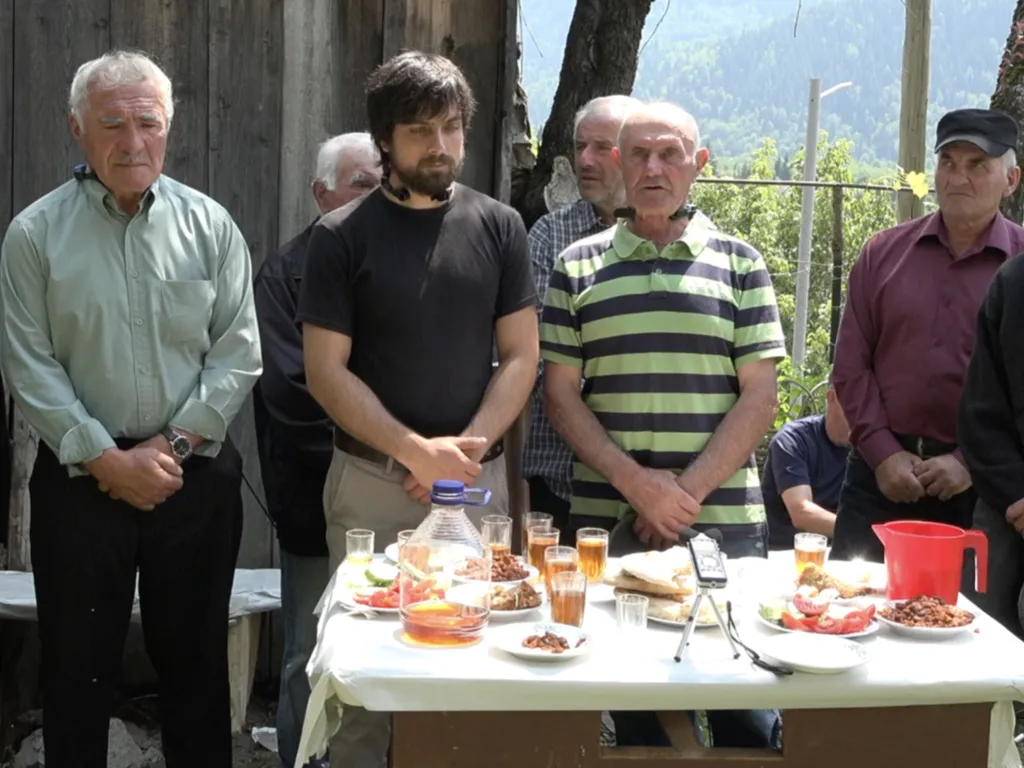
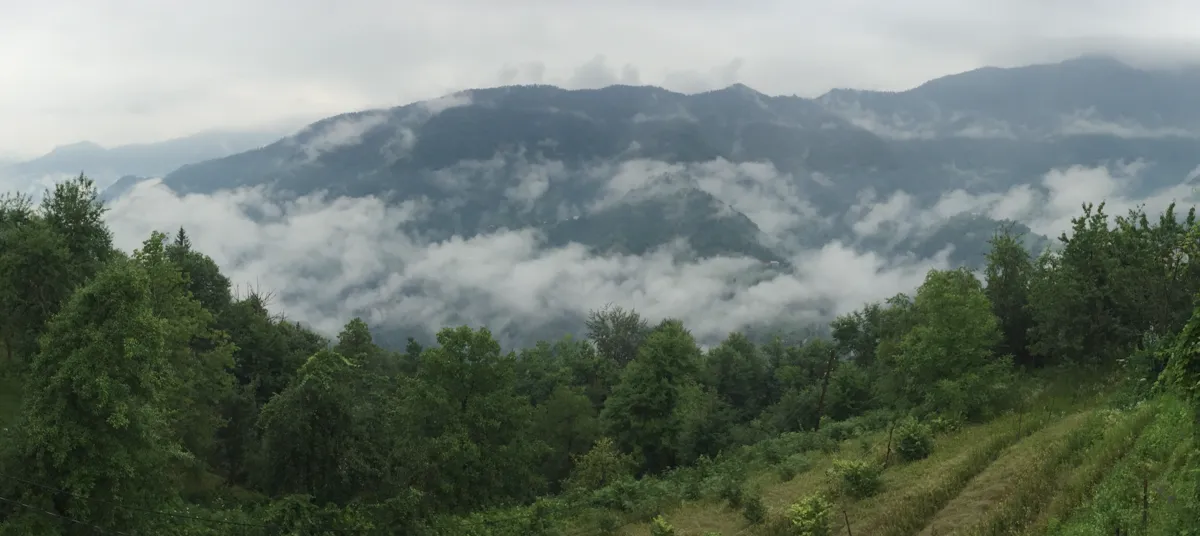
In July 2019 a team of the Potsdam project group, together with colleagues from the Tbilisi State Conservatory and the Georgian Chanting Foundation, travelled to south-western Georgia. The Tbilisi team wanted to collect recordings for a teaching CD. We wanted to test new, cable-free recording equipment that can also record singing dancers, gather material for future research and document current local music practice in sound and video.
We travelled for ten days and put together ten daily episodes from a small part of the video footage: personal impressions of the work, of the beauty of the country and of deeply moving encounters. We thank everyone who made this trip an unforgettable experience.
The daily episodes on YouTube:
- Day 1 (13:16 min): Arrival in Keda, first short session, drive on to Khulo
- Day 2 (15:07 min): Makhalakidzeebi (Oladauri community, Shuakhevi)
- Day 3 (10:08 min): Cultural Centre of Ghorjomi (Khulo)
- Day 4 (8:03 min): Cultural Centre of Khulo
- Day 5 (11:23 min): Cultural Centre of Skhalta (Khulo)
- Day 6 (13:54 min): Purt’io (Shuakhevi)
- Day 7 (23:24 min): Khabelashvilebi (Ch’vana, Shuakhevi), including a recording in a village mosque
- Day 8 (14:14 min): Mosque in Ch’vana and recording with the Turmanidze family in Merisi (Keda)
- Day 9 (5:34 min): Last recording session in Achara, Keda municipality
- Day 10 (18:28 min): Ozurgeti (Guria): testing the heartbeat sensors with a small group
When hearts beat in time
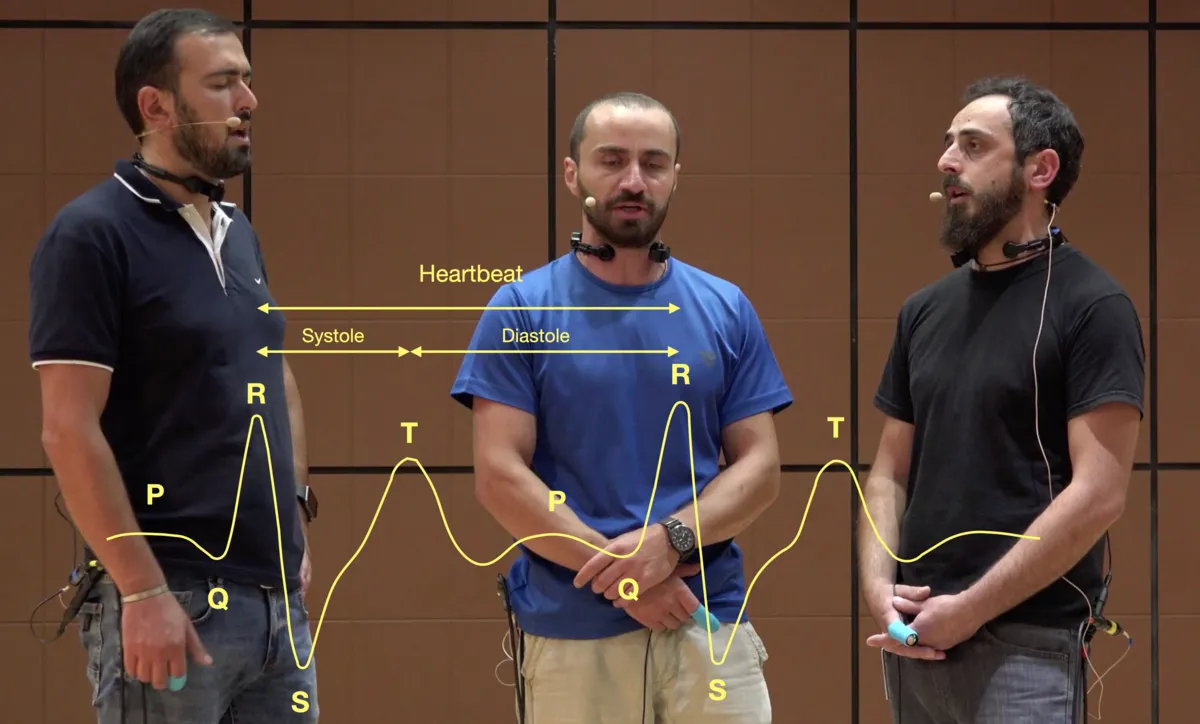
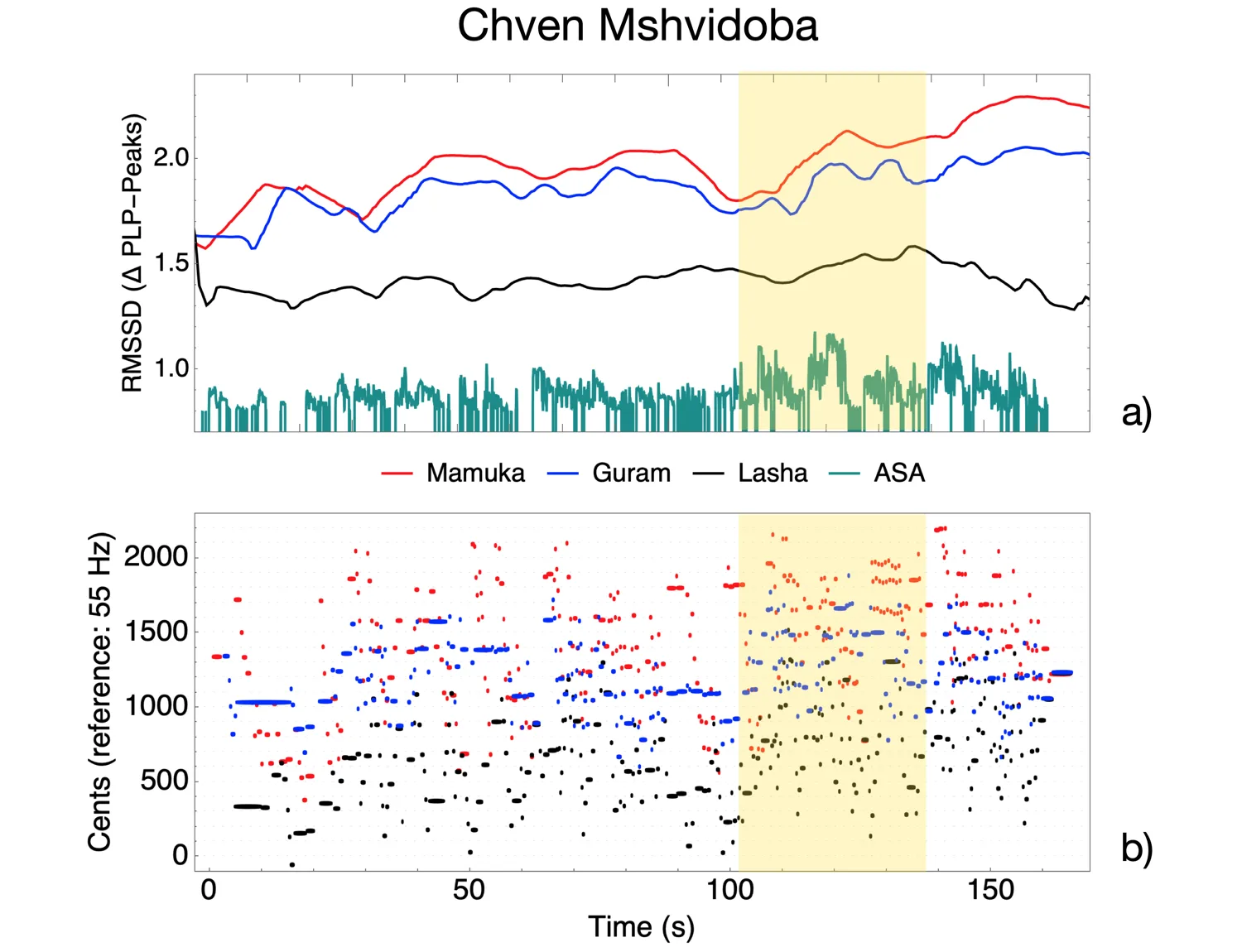
Does singing affect the heartbeat? In choirs singing in unison and with regular song structures, it has been observed that the singers’ heart rates can synchronise, probably in connection with their breathing. We wanted to know whether this also happens with more complex songs.
In July 2019 we carried out an experiment with the trio Khelkhvavi from Ozurgeti (Lasha Chkhartishvili, bass; Guram Guntadze, middle voice; Mamuka Siradze, top voice). During a recording session of about two hours the singers wore optical pulse sensors on their index fingers, and heartbeat, audio and video were time-synchronised. Details and results can be found in the paper by Scherbaum and Müller (2023) under Publications.
The Quintina: four singers, five voices
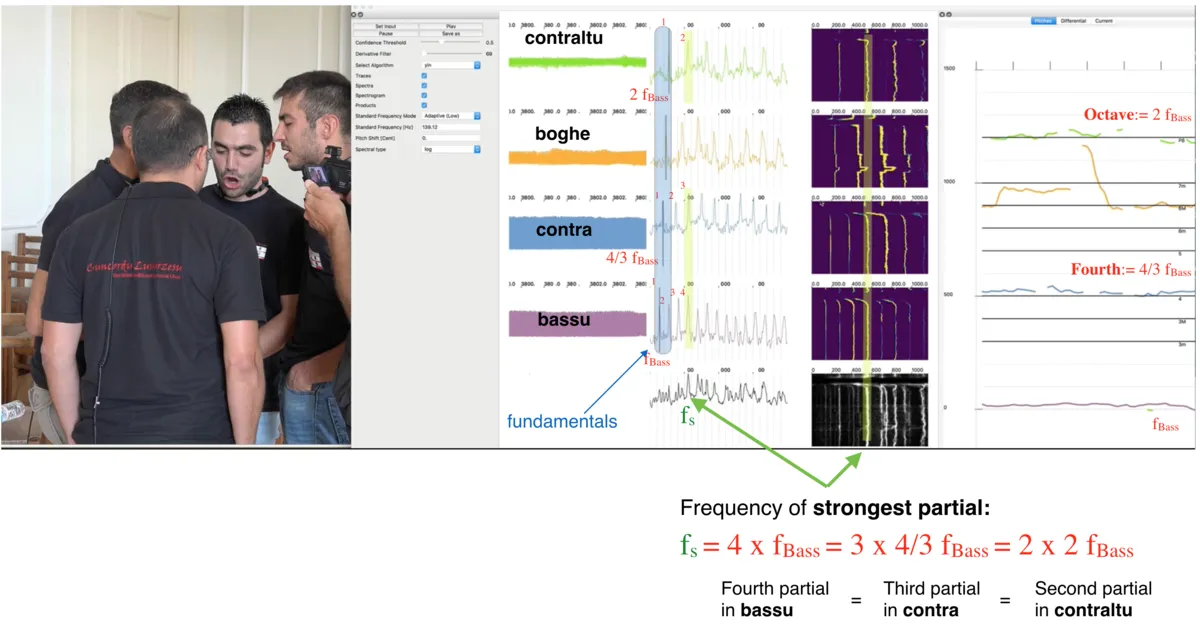
In a Sardinian singing style, the Quintina, four men sing so closely together that the high overtones of their voices fuse and an apparent fifth voice appears. The group Concordu Lussurzesu agreed to let us record this phenomenon with larynx microphones at a symposium in Tbilisi. The song was a Miserere, sung in the week before Easter.
With the program Pytch the voices can be watched in real time: for each singer you see the waveform, the spectrum and the pitch, and can follow how the voices adjust to each other.