Seismology and music
In short: Earthquakes and volcanoes generate vibrations, similar to musical instruments or the voice. Methods developed for music can therefore be applied to seismic signals.
The idea
The generation of sound and vibration inside the Earth is in some respects similar to sound generation in musical instruments and, for volcanic tremor, even to the human voice (for example Johnson and Watson, 2019; Schlindwein et al., 1995). This can be used for modelling and for extracting information. Research in Music Information Retrieval (MIR) has produced paradigms that are largely unknown in seismology, such as fingerprinting, source separation and onset detection.
The project
Within the DFG graduate school Natural Hazards and Risks in a Changing World (NatRiskChange), supported by the DAAD, we investigated in two research projects how MIR techniques can be used for hazard assessment and monitoring:
- Reza Dokht Dolatabadi Esfahani: time-dependent monitoring of active faults and landslides using new data-processing approaches from MIR.
- Zahra Zali: analysis of volcanic tremor with advanced signal processing, including MIR strategies.
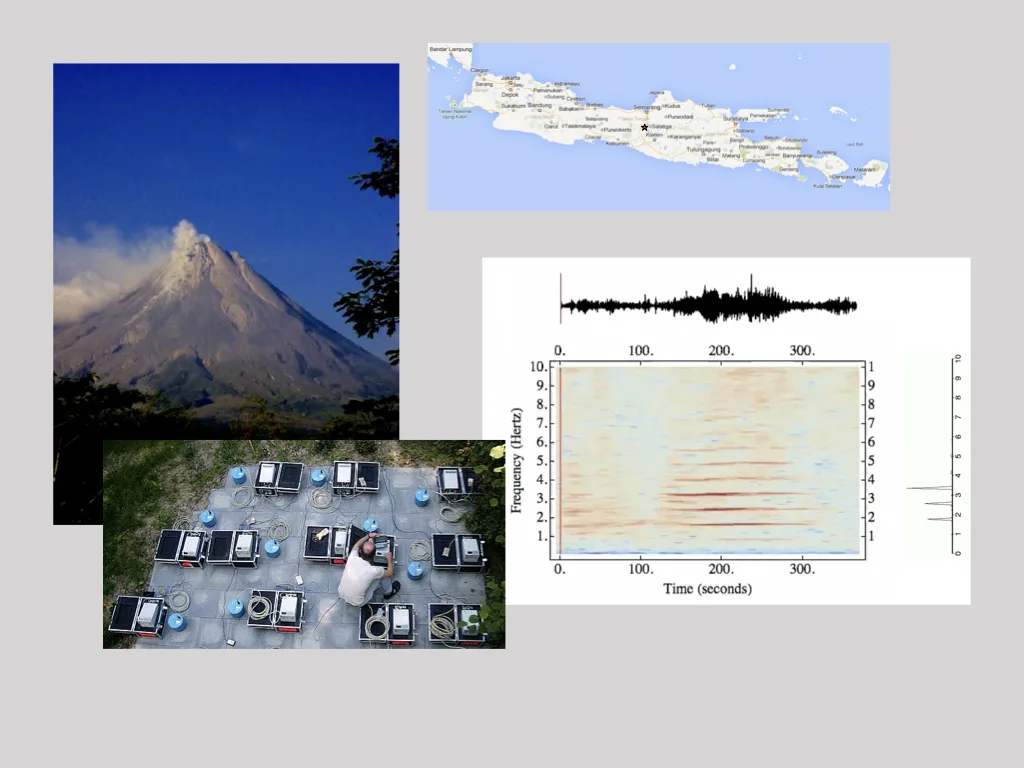
To listen: in the Soundscape Earth Lab you can hear volcanic tremor and other seismic signals yourself. More on the Soundscape Earth page.