Score analysis
In short: From the notation of Georgian songs one can read which chords follow which. We investigate whether rules lie behind this, like a grammar, and whether a learning program can discover these rules by itself.
How it began
In 2014, at the International Symposium on Traditional Polyphony in Tbilisi, Frank Scherbaum met the French ethnomusicologist Simha Arom. Best known for his work on African polyphony and polyrhythm, Arom had started to decipher the chord syntax of Georgian music with manually derived progression statistics (Arom and Vallejo, 2008; 2010). Scherbaum had read these papers and, out of curiosity, replicated the approach in Mathematica, which sped up the analysis considerably. It became a long-term collaboration on chord progressions in scores in Western five-line notation.
The grammar model
An important milestone is a generative grammar model based on the self-learning Kohonen model (Kohonen, 1989) in a prefix-tree framework. It is a significant improvement over the classical Markov model because each chord in a sequence may have a context of different length.
The model was used to generate a large number of chord sequences that follow the same production rules as the corpus. They trained an artificial neural network. As with large language models (LLMs), we asked whether “linguistic” relationships can be identified in the network’s embedding space.
- Chord to chord: inconclusive. The spatial structure of the embedding map for individual chords cannot be interpreted unambiguously.
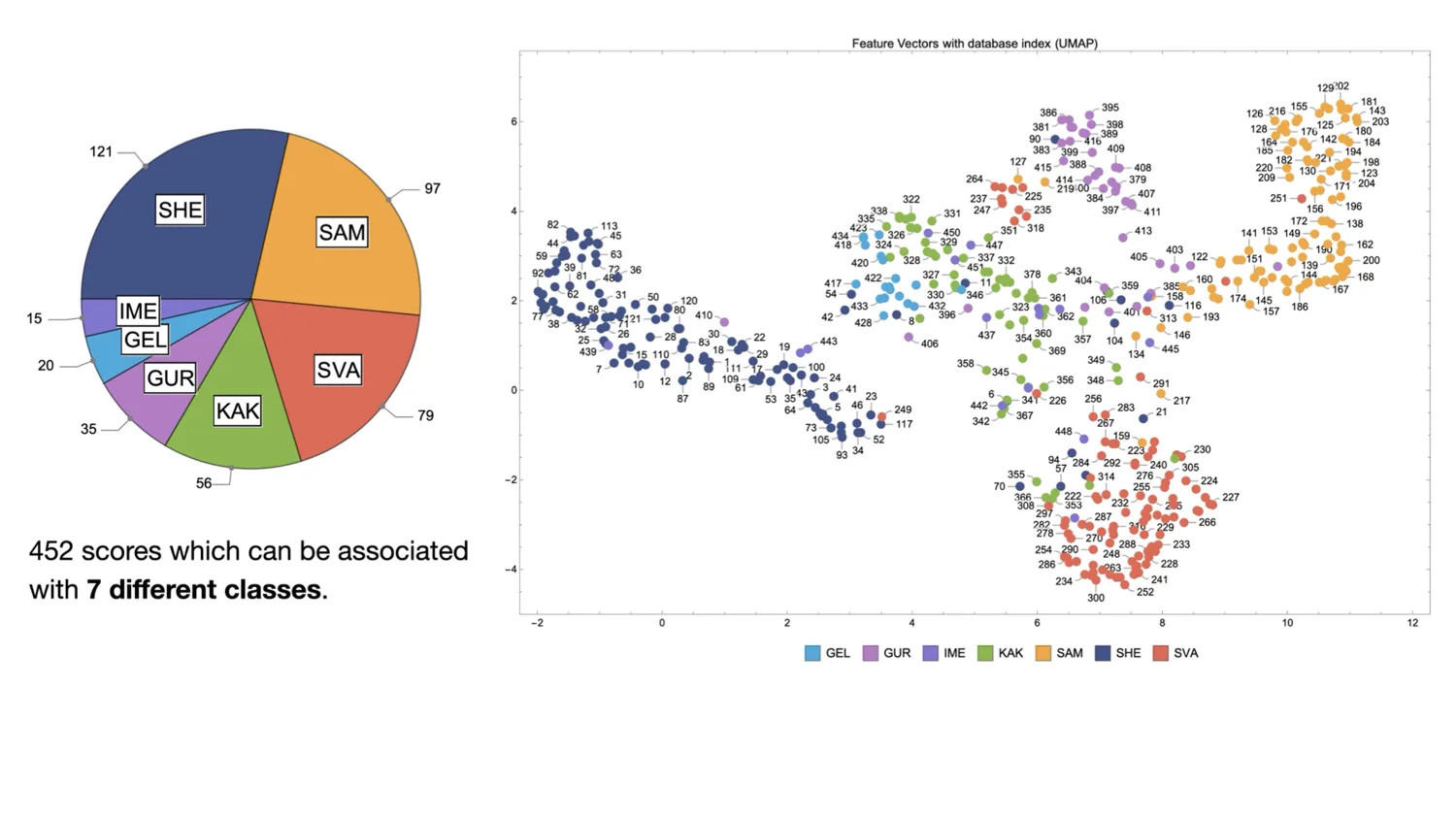
- Whole songs: pronounced clustering. The 452 scores of the corpus belong to seven classes (regions and/or schools), and these map to different regions of the embedding map. The network learned without supervision what makes the chordal syntax of songs similar or different.
Further reading
- Scherbaum, F., Arom, S., Caron-Darras, F. (2025). What can we learn about the grammar of traditional Georgian vocal music from computational score analysis? Musicologist 9(1): 1–29.
- Earlier work: Chordscapes and song paths
All publications: Publications.